"In the beginning, there was nothing at all. Earth was not found, nor Heaven above, a Yawning-Gap there was, but grass nowhere."In this lecture period we discuss:
Two Questions that have fascinated human beings are "how did the world begin", and "how did people come into this world"? In addition to this "creation" aspect, there have been two general ideas about the nature of the universe since the beginning of recorded history - (1) The universe always has been and always will be, just as it is (this is the "static" view), and (2) The universe had a beginning and thus will have an end (the "dynamic" view). These ideas are studied in the scientific field called Cosmology, and at this point in time the prevailing idea is that the universe is dynamic, and that in fact it started with a tremendously big bang. In the earliest times of recorded human history, it was thought that the earth was the center of the universe. This early view using Ptolemy's model of celestial bodies (Earth-centric) was replaced in the 1500s by Copernicus' demonstration that in fact the earth revolved around the sun (helio-centric). But even before this revelation, Aristotle among others believed that the earth, sun, stars, and universe were unchanging or "static". In addition to Aristole, Sir Isaac Newton and Albert Einstein also believe in a static universe -- some pretty heavy hitters in science, although Einstein hedged his bets by coming up with a fudge factor, the cosmological constant (which wasn't really a constant...) in order to account for observations of an expanding universe. In the 1850s astronomers started to measure that stars and nebulae appeared to be moving away from earth. However, at that time the resolution of telescopes wasn't that great, and in the early 1900s there was a big push for larger telescopes. By 1917 a new 100 inch telescope, nearly twice the size of the largest telescope at the time, was completed at the Mt. Wilson observatory in California. The "Hooker telescope" (named for the benefactor), was put to good use right away, and by 1923 Edwin Hubble had proved that the Andromeda galaxy was outside of our own galaxy. Hubble continued to measure stars and nebulae and found that nearly all of them were "redshifted", meaning that they were moving away from earth and thus verifying that the universe was dynamic, and expanding. Hubble further discoverd that the stars farthest away were moving fastest, and he had the insight to recognize that with a velocity of recession (moving away) and a distance to certain stars used as calibration points (Cepheid stars), we could calculate the age of the universe, or the age since the "Big Bang". To continue on with this story we first need some basic information on radiation, physical laws, and finally the evidence for the Big Bang.
From the University of Colorado
RadiationElectromagnetic
Radiation includes visible light, radio waves, microwaves, x-rays,
gamma rays, and infra-red (heat) rays. All these forms of radiation
are characterized by traveling oscillations of a combined electric
and magnetic field. These electromagnetic waves differ by the
wavelength of the oscillation, with shorter wavelength radiation
carrying more energy than longer wavelength radiation.
All possible wavelengths make up the
electromagnetic
spectrum.
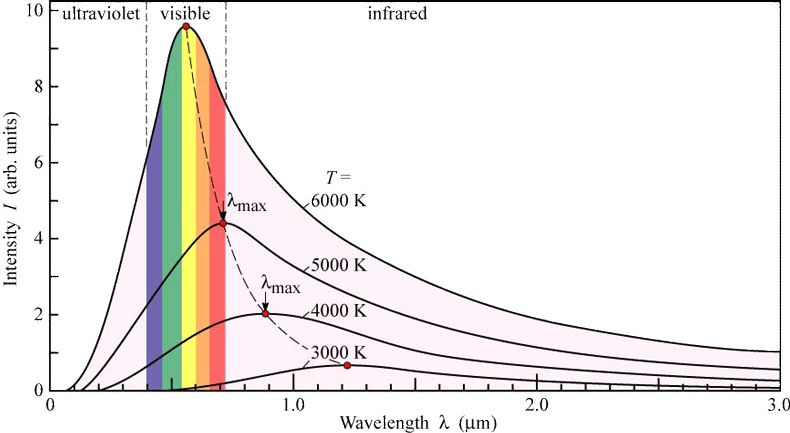
Planck's LawPlanck's Law is sometimes
called the "black-body" formula works very well for
celestial bodies:
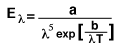
Where E (lambda) is the
amount of radiant energy emitted at a given wavelength, lambda. T is
the temperature of the object, and a and b are constants.
The spectrum of wavelengths emitted by a body at a temperature, T, has a characteristic shape that is strongly dependent on the wavelength (to the inverse fifth power).
This law describes the spectral distribution of radiation emitted by a black body. Very hot bodies (3000 - 20,000 K) like our Sun emit a lot of light at visible wavelengths. The Sun acts like a black body near 6000K, whereas the Earth acts like a black body near 300 K (can you guess where its curve would lie?). Stefan-Boltzmann Law ("E equals sigma T to the fourth")

where E is the total energy emitted (calculated by adding up the areas
under the curves of Figure 1), sigma is a constant, and T is temperature.
Wein's LawThe wavelength
of the peak radiance [lambda (max)] decreases linearly as the temperature
increases, where c is a constant:

Summary of radiation laws
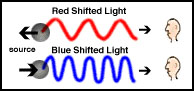
The Doppler Effect
Click here to see how the speed of an object affects wavelength. The Doppler Effect for Light is calculated by:
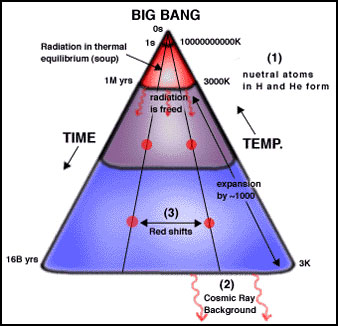
Big Bang TheoryThe Big Bang theory states that the Universe began when primordial mass exploded. This fireball gradually cooled as it expanded outward, and giant clouds of swirling gas formed the celestial bodies. The Big Bang theory does not explain why the bang occurred, but predicts (with surprising accuracy) what the consequences of the event. Evidence #1: atomic physicsIf the big bang occurred, the initial temperatures must have been so unimaginably high that matter could only have existed in exotic and unstable forms. As the temperature cooled in the first second, free hydrogen nuclei (atomic mass 1) were formed that could undergo fusion reactions to give heavier forms of hydrogen (atomic mass 2, 3) and helium (atomic mass 3 and 4). Thus, the theory predicts a early universe with only a mixture of ~75% hydrogen and 25% helium (by weight) and no heavier species. This ratio is exactly what is observed in stars. Evidence #2: red shiftMeasurements of the red shifts of virtually all galaxies (except a few in our immediate vicinity) show that the visible universe is expanding in all directions. The constant of proportionality between the distance and velocity of recession is known as Hubble's constant. Evidence #3: microwave radiationMeasurements of low energy microwave radiation show that the visible universe is permeated by "cosmic background" microwave radiation, coming from all directions and similar to what is expected from a black body at 3K. The Big Bang theory predicts that such radiation is the red-shifted remnant of the radiation released when matter and light became decoupled about 1 million years after the Big Bang. The American scientists who first made this measurement in 1965 (Penzias and Wilson) obtained the Nobel Prize.
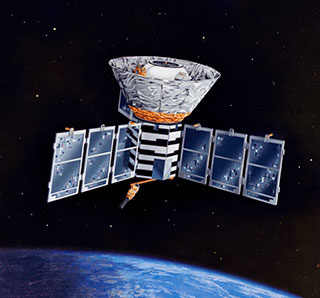
COBE satellite results show that the cosmic ray background is not completely uniform in direction (see Figure), but that there is some clumping in preferred directions with differences in effective temperature of only one hundred millionth of a degree. This clumpiness would have been necessary for the big bang to produce galaxies, since a perfectly uniform explosion would not produce localized high densities.
All materials © the Regents of the University of Michigan unless noted otherwise. |
||||||||||||||||||
 : A pdf
file on this material will be available on your Canvas site
: A pdf
file on this material will be available on your Canvas site 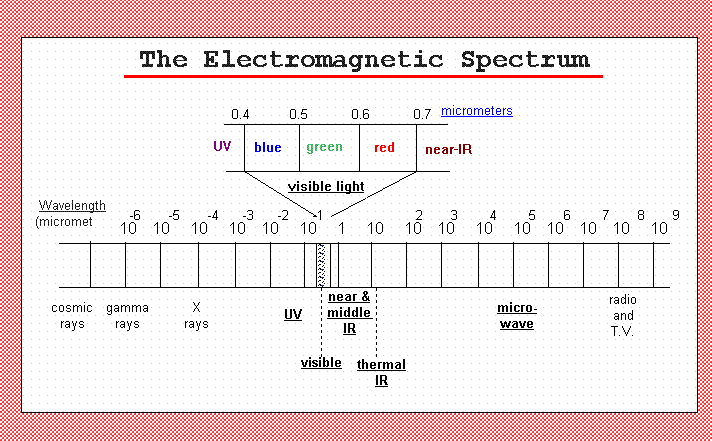

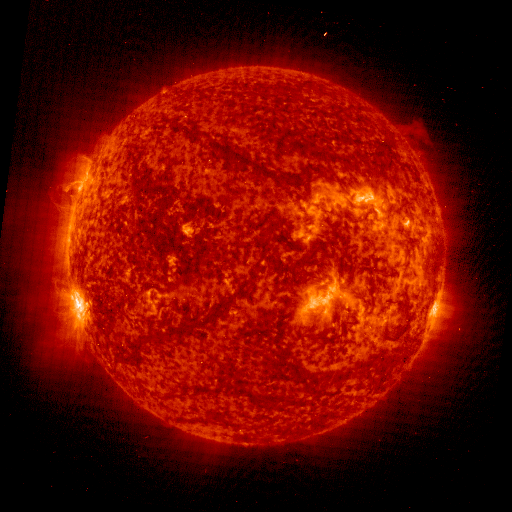
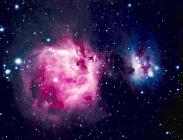
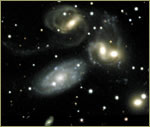
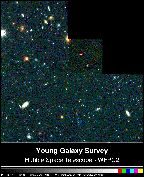 The
visible universe contains at least 100 billion galaxies - these are incredible
numbers. This image is of very young galaxies observed by the Hubble Space
Telescope at the very limit of its range. The sky is full of such strange
looking galaxies in all directions (except where masked by intervening
dust clouds). The universe is home to a variety of exotic objects. For
example,
The
visible universe contains at least 100 billion galaxies - these are incredible
numbers. This image is of very young galaxies observed by the Hubble Space
Telescope at the very limit of its range. The sky is full of such strange
looking galaxies in all directions (except where masked by intervening
dust clouds). The universe is home to a variety of exotic objects. For
example, 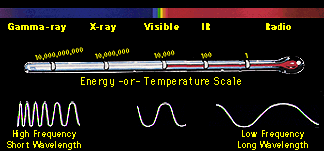
 Measurements from the